
Table of Contents
Blowers racing is the branch of drag racing built around supercharged engines, where a belt-driven blower forces more air into the cylinders and turns a small-block or big-block V8 into a four-digit horsepower package. Fans know it for the whine, the fuel fumes, and the violent launch off the line. This guide explains how a blower makes power, which classes run one, and what to watch at the strip.
What Is Blowers Racing?
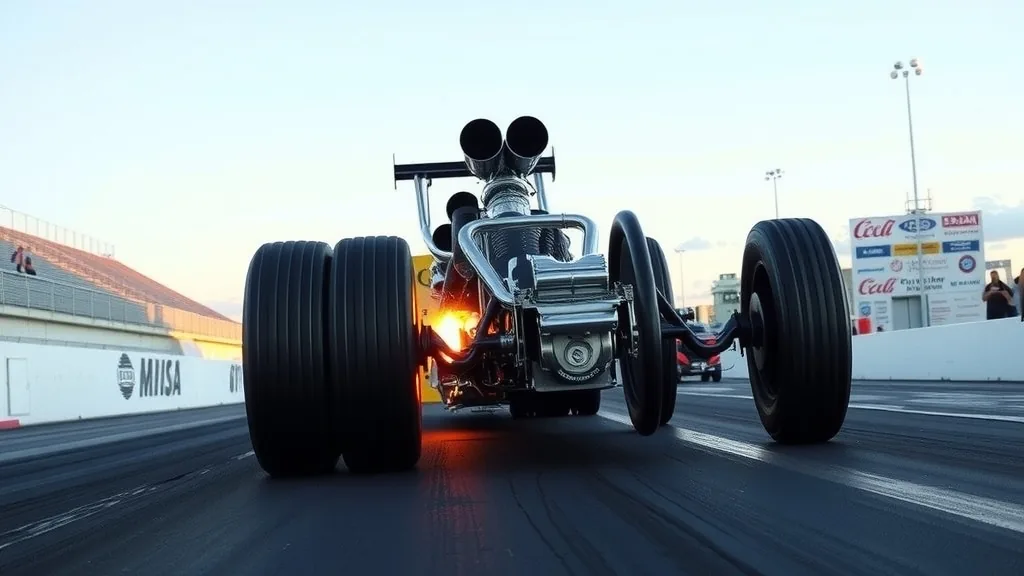
Blowers racing is any drag racing class where the engine is fed by a mechanical supercharger rather than a turbocharger or natural aspiration. The blower sits on top of the intake, driven by a belt from the crankshaft, and pumps a fixed volume of air on every revolution. Because the air is compressed, the engine can burn far more fuel in the same displacement.
The look is unmistakable: a large rectangular case above the engine, usually topped by an injector hat on nitro cars. In the pits you will hear crews talk about overdrive, boost, and the tune-up rather than turbo lag or wastegates. That vocabulary is the clearest sign you are watching a blown combination.
The format is simple. Two cars leave the line together, run a measured distance, and the first to the finish wins unless a foul or a mechanical failure intervenes. What makes blowers racing different is how much of the result is decided before the tree ever drops.
How a Blower Makes Power
A Roots-type blower is a positive-displacement pump. Two counter-rotating rotors trap air at the inlet and move it to the manifold, so airflow rises with engine speed instead of waiting for exhaust energy. That gives the engine a linear, immediate supply of oxygen, which is exactly what a drag car needs on a short run.
More air only helps if the fuel system can keep up. Blown alcohol and nitro engines use mechanical injection, and the injector hat sits above the blower so fuel is drawn in and mixed as the air is compressed. The tune-up is a balance between making power and not melting parts in four seconds.
| Part | Job | Why it matters |
|---|---|---|
| Blower case and rotors | Pump air into the intake | More oxygen supports more fuel and more power |
| Overdrive ratio | Spin the blower faster than the crank | Sets boost and how hard the engine is stressed |
| Injector hat | Feed and mix fuel above the blower | Controls the fuel curve on a short, violent run |
| Clutch and rear tires | Manage the launch | Turns horsepower into forward motion instead of smoke |
Boost numbers on a blown drag engine are not comparable to a street turbo. The run lasts seconds, the engine is rebuilt on a schedule measured in runs, and the whole package is designed around a single goal: maximum average power over the strip.
From Land Speed Records to the Drag Strip
Supercharging is older than drag racing. In the 1920s and 1930s, land speed record drivers such as Henry Segrave and Malcolm Campbell used blown engines to push past 200 mph on sand and salt. The same idea moved to dry lakes and salt flats in the United States, where builders learned that a belt-driven blower was the simplest way to make big power.
After the Second World War, surplus aircraft and automotive parts made superchargers affordable. Drag racing grew out of those dry-lake runs, and the blower became a signature of the fastest classes. The technology has changed far less than the safety equipment around it.
Classes That Run a Blower
Top Fuel and Funny Car are the best-known blown classes. Both use a supercharged nitro-burning engine, and both run the shortest, most violent form of the sport. A Top Fuel dragster covers 1,000 feet in roughly 3.7 seconds and reaches speeds near 335 mph.
Blown alcohol classes are more accessible. Pro Mod, blown alcohol dragster, and several regional categories use a supercharged engine on methanol, which runs cooler than nitro and costs far less per pass. These are often the best place for a new fan to watch how a crew chief reads a track.
The sanctioning body matters when you are looking for an event. The NHRA is the primary organizer for national-level blown classes in the United States, while many tracks run their own blown alcohol and nostalgia programs.
What to Watch on Race Day
Start with the burnout. The crew heats the tires to make them sticky, then the car reverses into the beams. Watch the front wheels during staging and the rear tires at the launch; a car that shakes or spins is already in trouble.
Then watch the scoreboard. The 60-foot time tells you which car hooked up, and the speed at the finish tells you which one kept making power. A car can win on elapsed time and still lose miles per hour, which usually means the tune-up was aggressive early and soft late.
Cost, Commitment, and Getting Close to the Sport
Blowers racing is expensive at every level, and the cost curve is steep. A competitive blown alcohol operation needs a dedicated tow rig, a spare engine or two, a trailer full of tires, and a crew that can rebuild a combination between rounds. Nitro teams add a fuel bill that dwarfs everything else.
For fans, the entry point is much cheaper. Most national events sell a pit pass that lets you walk the lanes, watch a rebuild, and talk to crews between rounds. That access is the reason blowers racing keeps a loyal audience: the sport is loud from the grandstand and surprisingly open in the pits.
If you want to compete, start with a nostalgia or blown alcohol class rather than a headline category. The cars are simpler, parts are easier to find, and the schedule is shorter. Many drivers move up only after several seasons of consistent runs.
Keep Exploring
If you enjoy the technical side of motorsport, Martinsville Speedway, the short-track opposite of blowers racing, is the other extreme: low power, heavy braking, and a lap that rewards patience. For the broadcast side of the sport, see what NASCAR on USA Network puts on screen each week.
What is a blower in drag racing?
A blower is a mechanical supercharger driven by a belt from the crankshaft. It pumps compressed air into the engine so more fuel can be burned, which raises horsepower without increasing displacement.
Are blowers the same as turbochargers?
No. A blower is driven mechanically by the engine, while a turbocharger is driven by exhaust gas. Blowers respond immediately and are simpler to tune on a short drag run, but they draw power to drive.
Which drag classes use superchargers?
Top Fuel and Funny Car use supercharged nitro engines, while Pro Mod and several blown alcohol classes use supercharged methanol engines. Many regional and nostalgia events also run blown combinations.

John Oey is a senior sports writer at Blowers Racing covering NASCAR, drift, Olympics, and sports analytics. 7+ years, 180+ guides. Method: official rulebooks, historical archives, and statistical databases. Author of 1,750 sports guides since 2022.



More Stories
Time to Place Your Bets – Even on Some Weird Wagers
Ford Mustang – Third Party Variants
The Good Thing About Oxley Edge