
Table of Contents
Drift racing culture grew out of Japanese mountain-road driving in the 1970s and 1980s and became a judged motorsport with its own cars, vocabulary, and global circuit. A drift is a controlled slide held past the point where the rear tires grip, and competition rewards angle, line, and style rather than the fastest time.
What Is Drift Racing Culture?
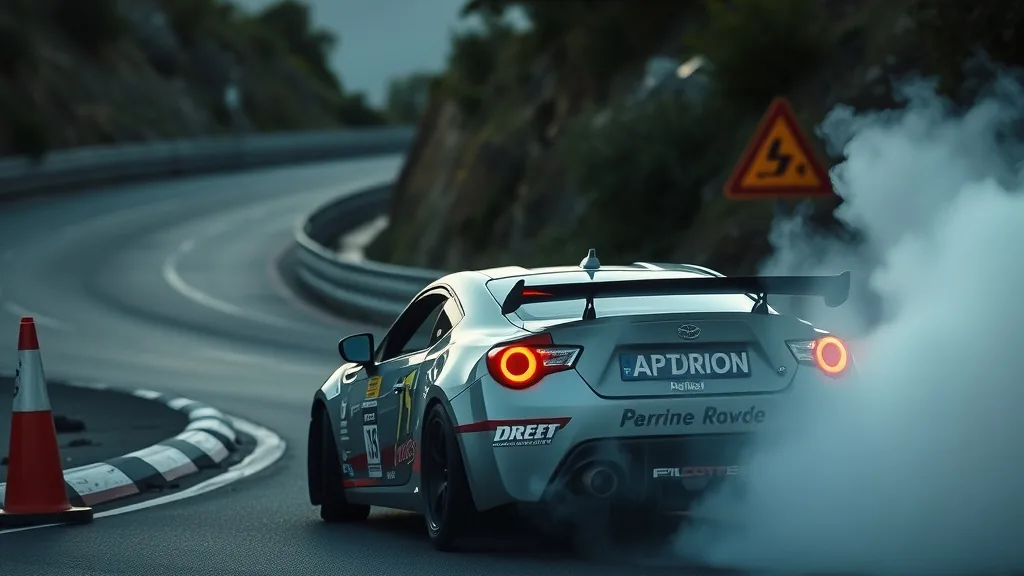
Drifting is the deliberate use of oversteer to rotate a car through a corner while maintaining forward momentum. The driver breaks the rear tires loose with power, a clutch kick, or a weight transfer, then counter-steers to hold the slide. A clean run looks smooth because the corrections are small.
Judged drifting is not a race in the usual sense. Two cars may run head to head, but the winner is chosen by judges who score each run against a rubric. That is why a slower, cleaner run can beat a faster, messy one.
The culture around the sport is as important as the competition. Drivers, teams, and fans share a visual language: decals, liveries, camera angles, and a soundtrack built on high-revving four-cylinder and rotary engines.
Japanese Roots and Global Spread
The origin story starts on mountain passes, or touge, where enthusiasts learned to slide lightweight rear-wheel-drive cars through tight corners. Kunimitsu Takahashi is often credited with the racing technique, and Keiichi Tsuchiya, known as the Drift King, popularized it through magazine coverage and video.
The first organized series, D1 Grand Prix, launched in Japan in 2001 and standardized judging. Formula Drift followed in the United States in 2004, and national series now run in Europe, the Middle East, and Australia. The rules differ, but the vocabulary is shared.
Where the Scene Lives Today
Competition is only part of the scene. Cars and coffee meets, livery reveals, and behind-the-scenes build videos carry the culture between events, and a driver’s personality matters as much as lap time. That is closer to skateboarding than to Formula 1.
The visual side is deliberate. Teams design liveries for camera angles, and content creators plan shots around the same corners the judges watch. A clean run that films well can do more for a driver’s career than a podium finish.
Grassroots events keep the pipeline open. Open drift days let a beginner slide a street car in a controlled environment, and local series provide a ladder without the cost of a national program. Most professional drivers still name those events as where they learned car control.
How Runs Are Judged
Judges usually score four things: the line through the course, the angle of the car, the style of the transition, and the speed carried. Contact with a barrier or a cone can end a run, and a car that straightens out loses angle score quickly.
| Criterion | What judges look for |
|---|---|
| Line | Following the ideal path, including the clip zone at the apex |
| Angle | How far the car is rotated relative to the course |
| Style | Clean transitions, commitment, and control under pressure |
| Speed | Momentum carried through the course without straightening |
The Cars That Define the Sport
Lightweight rear-wheel-drive coupes dominate: the Toyota AE86, Nissan Silvia S13 and S14, Mazda RX-7, and BMW E36. Later cars such as the Nissan 350Z and Toyota GR86 are common in pro competition because they are stronger and easier to source parts for.
Builds focus on steering angle, suspension geometry, a locked or limited-slip differential, and cooling. Power matters, but a car that will not hold angle at low speed is harder to drive than a modest car with a well-set-up front end. Tires, weight, and gearing then decide how long a driver can hold a slide without straightening.
How Drift Racing Culture Reaches New Drivers
Most drivers start at open track days and grassroots events, often in a stripped street car. Local series and drift taxis give seat time without the cost of a pro program. Tires are the biggest recurring expense, which is why amateur events often run used or control tires.
Progression depends on consistency rather than raw bravery. Judges reward a driver who can repeat a run, and teams look for someone who can give useful feedback to a mechanic. The same discipline applies in other motorsport: blowers racing, the drag-strip cousin of drift racing culture, rewards repeatable launches, and a short oval like Martinsville Speedway rewards repeatable braking.
Judging also shapes how drivers practice. A run that looks spectacular but misses the clip zone scores lower than a tidy run that hits every mark, so teams spend hours reviewing footage frame by frame. That feedback loop is why the sport produces such precise car control.
For the official competition rulebook and event calendar, use Formula Drift as the primary source.
Is drifting a race or a judged sport?
Competitive drifting is judged, not timed. Judges score line, angle, style, and speed, and head-to-head battles are decided on those criteria rather than who crosses a line first.
What cars are best for drifting?
Lightweight rear-wheel-drive cars with strong aftermarket support are the usual choice, such as the Toyota AE86, Nissan Silvia, Mazda RX-7, and BMW E36. A well-set-up front end matters more than raw power.
How do you start drifting?
Most drivers begin with open track days and grassroots events in a rear-wheel-drive car. Seat time, a safe venue, and instruction matter more than a heavily modified build at the start.

John Oey is a senior sports writer at Blowers Racing covering NASCAR, drift, Olympics, and sports analytics. 7+ years, 180+ guides. Method: official rulebooks, historical archives, and statistical databases. Author of 1,750 sports guides since 2022.



More Stories
10 Secrets to Winning More Greyhound Races
Ford Mustang – Third Party Variants
The Good Thing About Oxley Edge